Dear parent,
We are the authors and publishers of the Reading Lesson, a very popular book for teaching young children to read. Over 200,000 families have taught their children with the Reading Lesson. Learning to read is the first step on the road to academic success.
But it is a one-time skill. Mathematics, on the other hand, is a continuing learning process spanning many years, sometimes a decade or more. It is a step-by-step process where new learning must rest on the old, previously learned skills.
In many countries where math skills are highly prized, such as Russia, India and China, math is taught differently than in the western world. There is a lot of emphasis on mastering math facts. They teach many mathematical tricks to speed calculations. Also, much of early math is taught verbally or mentally, which is often called mental math.
Doing basic arithmetic in your head, frees your child from tedious and necessary task of handwriting, while improving accuracy and speed. You must have seen children sitting dejectedly in front of a math worksheet full of numbers! The ubiquitous worksheets frustrate the child while the child can easily come up with the correct answers without having to write it down. A an hour long slog in front of a worksheet becomes a happy ten-minute game.
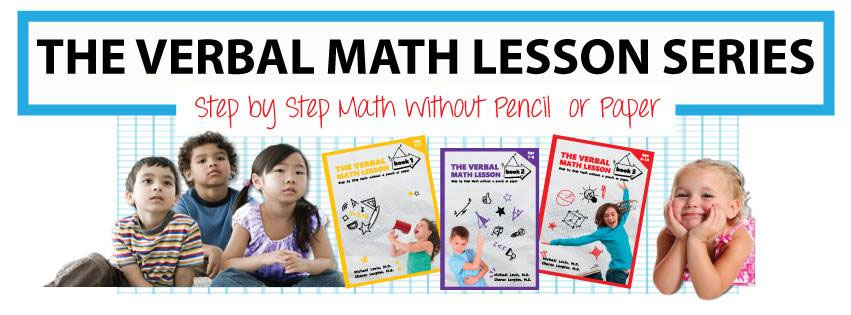
Most children will happily do math problems verbally if they can think of it as a game. Our Verbal Math books do just that.
So ditch worksheets and show your child how to do math, as it is meant to be done, without pencil or paper, and as a game with Verbal Math Lesson books.
Best,
Charan and Michael
PS: Questions, comments, please contact us.
Math without pencil or paper
Make math fun




